Four products hiding under one label
The phrase “AI notes” can describe meeting transcription, a writing editor, an AI knowledge base, or a personal memory. Their interfaces may all contain chat boxes, but their inputs and success criteria are different.
A meeting tool succeeds when the transcript and action items are accurate. A writing tool succeeds when it helps shape an idea. A memory app succeeds when it retrieves the right prior item and proves where the answer came from.
Compare the workflows
| Category | Primary input | Primary output |
|---|---|---|
| Meeting notes | Audio and calendar meetings | Transcript, summary, actions |
| AI writing | Your draft and prompts | Rewritten or generated text |
| Knowledge base | Documents and web sources | Synthesis and connections |
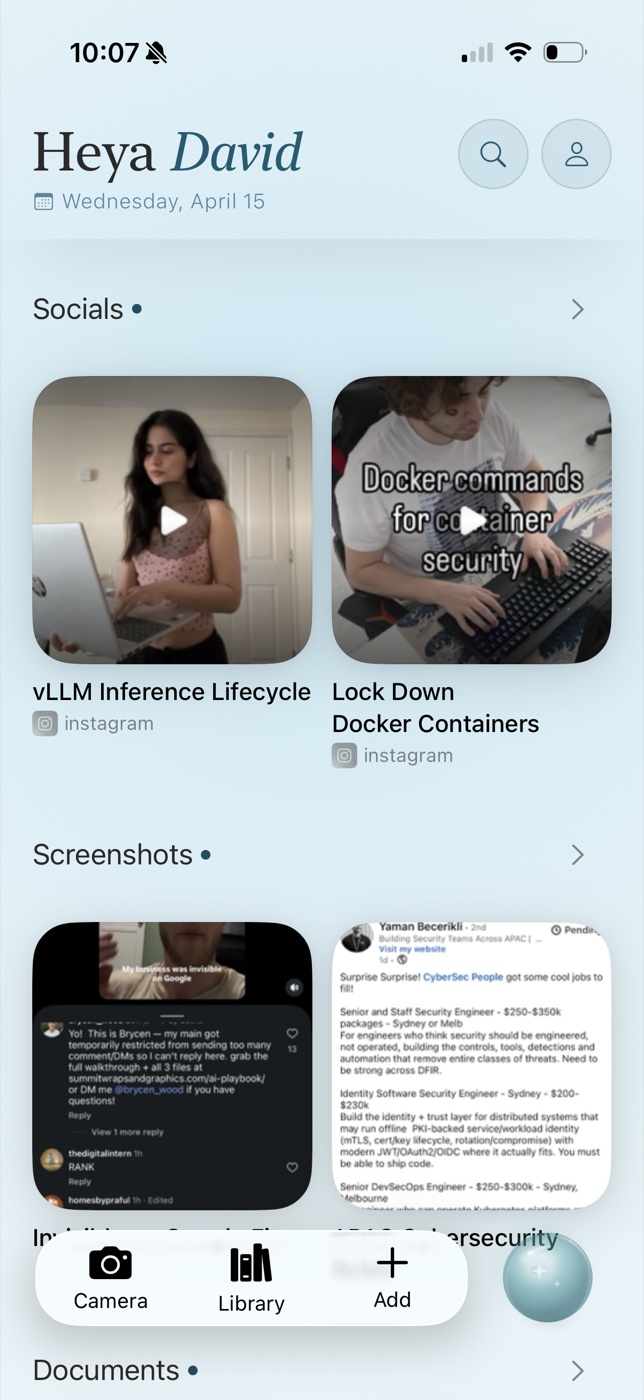
| AI memory | Everyday captures across apps | Retrieval with the original source |
When an AI memory is better
Use a memory app when capture is distributed and the future question is unpredictable. You might remember the colour of a screenshot, the idea from a reel, or the context of a saved PDF but not its title.
OwnMynd combines semantic search with source-backed answers on iPhone. That makes it closer to a private retrieval layer than a replacement for Apple Notes, Craft, or a meeting recorder.
Avoid the universal AI workspace trap
A product that records every meeting, reads every file, writes every document, and remembers every personal detail may be convenient, but it also concentrates risk and creates a noisy corpus. Choose the minimum scope that solves the problem.
Evaluate citation quality, deletion, export, offline behaviour, and data handling. Then test with your own messy examples. A polished demo using perfectly titled documents reveals very little about real recall.
Try recall without the filing
OwnMynd AI is a private memory app for iPhone and iPad. Save screenshots, links, notes, documents, and social content, then retrieve them with the source attached.
View on the App StoreFrequently asked questions
Can an AI memory app replace a notes app?
Usually not. It can reduce the need to organise captured material, but a dedicated editor remains better for deliberate writing.
Are meeting notes a form of digital memory?
Yes, but meeting tools optimise for audio capture and action items. Personal memory apps cover a broader set of everyday sources.
Why are citations important?
They let you verify the answer, recover surrounding context, and distinguish retrieval from plausible generation.
Research sources
Product capabilities were checked against official pages from mymind, Recall, Fabric, Raindrop.io, Obsidian, Notion, Zotero, Readwise Reader, Evernote, and OneNote. Comparison structure was also reviewed against NotePlan's Notion alternatives and Obsidian alternatives guides. Features and pricing can change; verify critical details with the provider.
Continue reading
- How to Save and Manage Web Links, Notes, and Social Media Posts
- The Best iOS Apps for Organizing Research and Reference Material
- The Best Evernote Alternatives in 2026
Editorial note: Product capabilities change. This guide was reviewed against public product information available on 14 June 2026. We identify where OwnMynd is and is not a suitable choice.